Food prices and unemployment are rising. This coupled with the assault on the common man, those in the lower and middle class, by the Wisconsin government and Maine´s government have begun a people´s protest.
....But unions are right to be worried. Declining membership, being squeezed out of the private sector, and anti-union attitudes have all contributed to the labor movement's deterioration since the McCarthyist 50s, but particularly since the Reagan era. A blow like Wisconsin could never have been struck without the last 40 years of the slow debilitation of the unions after the incredible build-up of the workers' movement in the first half of the 20th century.
The corporations have been fighting a century long war of attrition, while we organizers have been either too-focused on the day-to-day, too-focused on the distant Revolution, or too willing to believe the myth of our own weakness.
The economy is but one indication that the current system hangs by but a thread. The environment is another. It's time we realized our own potential, our own power, and took advantage of the perpetual crisis to make a lasting change through overcoming--or at least balancing out--the over-concentration of wealth and power in the hands of the few and redistributing them among the many.
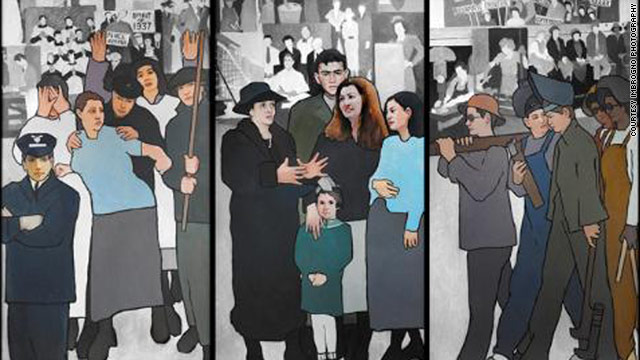
Look around you. All is not right, all is not equal. Stop the wars! stop the war on workers!
Even children understand equal and fair. It is only when we ¨grow up¨ that we tend to rationalize why things are not fair. Why our brothers and neighbors have less or more. They don´t work hard enough, they are not smart enough. Or they are rich because they worked hard or perhaps are ¨self-made¨. Nothing happens by it self, the CEOS of any business are nothing without the worker, the labor. The amusement park does not run without the ticket taker, computers are not made by fairies, on and on. Even Henry Ford knew if he did not pay his workers a fair wage they would not be able to buy the same cars they were making.
¨.....Although the Model T had made Henry Ford rich and famous, he continued to advocate for the masses. In 1914, Ford instituted a $5 a day pay rate for his workers, which was nearly double what workers were paid in other auto factories. Ford believed that by raising the workers' pay, the workers would be happier (and faster) on the job, their wives could stay home to care for the family, and the workers were more likely to stay with the Ford Motor Company (leading to less down-time for training new workers). Ford also created a sociological department in the factory that would examine workers' lives and try to make it better. Since he believed he knew what was best for his workers, Henry was very much against unions.¨
Solidarity!

 Tenth floor of Asch building after Triangle fire

 For many more photos go to
  [/caption]
 [/caption]
 [/caption]
 [/caption]
 [/caption]